Synebo
Turned Salesforce-niche SEO into a deal channel — 2.73× traffic and MQL-to-SQL conversion up from 17% to 29%.
- 2.73× organic traffic
- MQL→SQL 17% → 29%
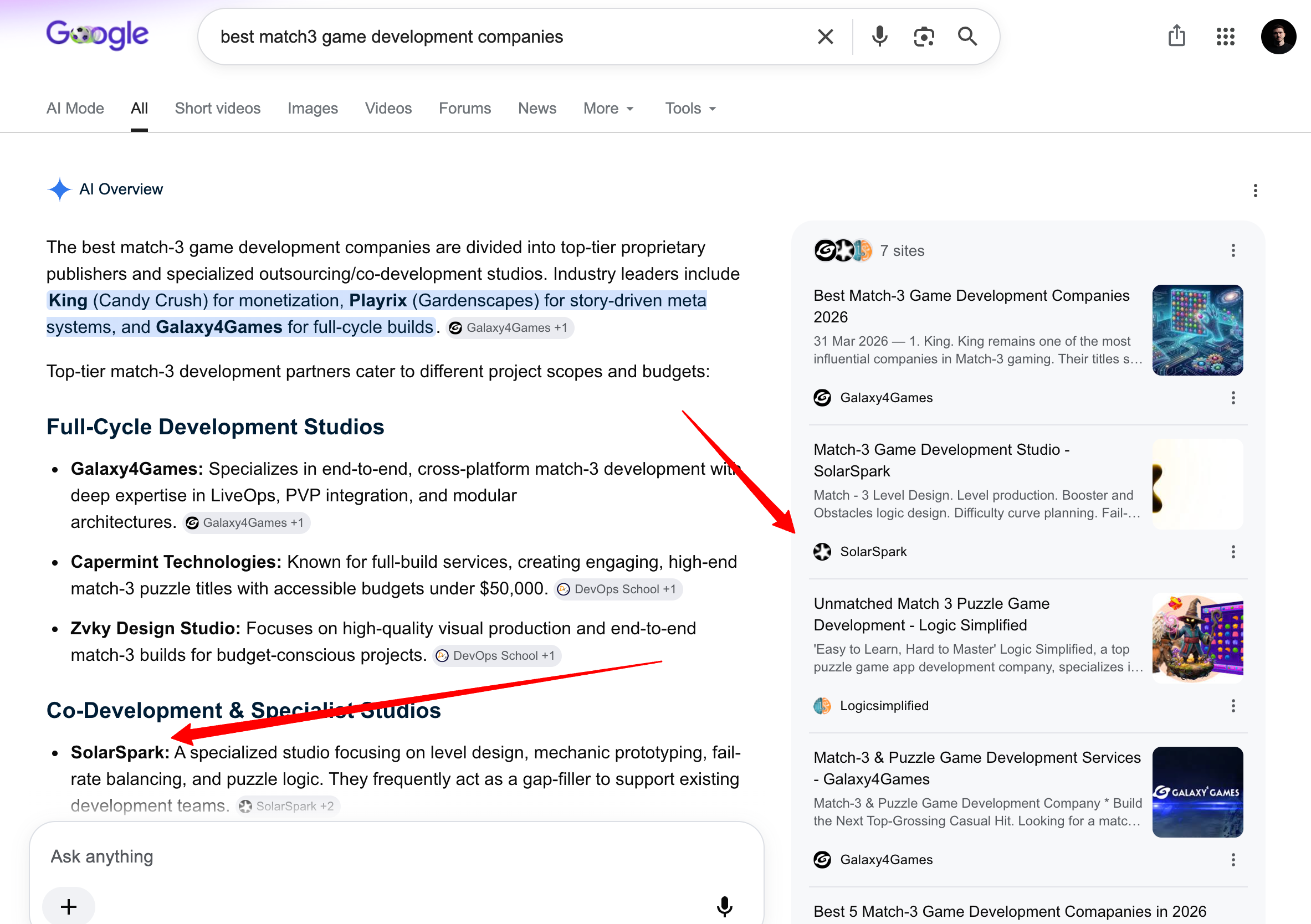
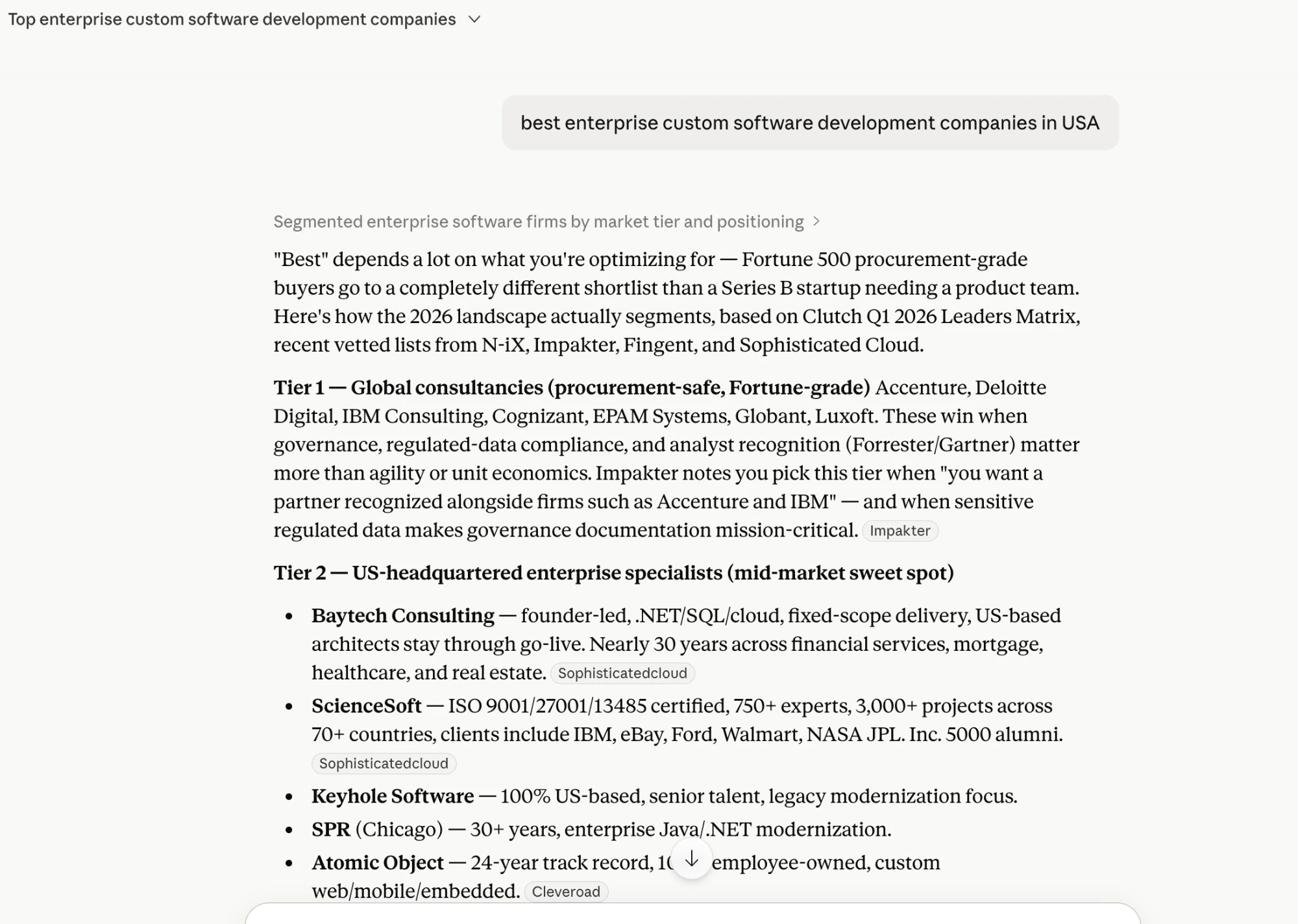
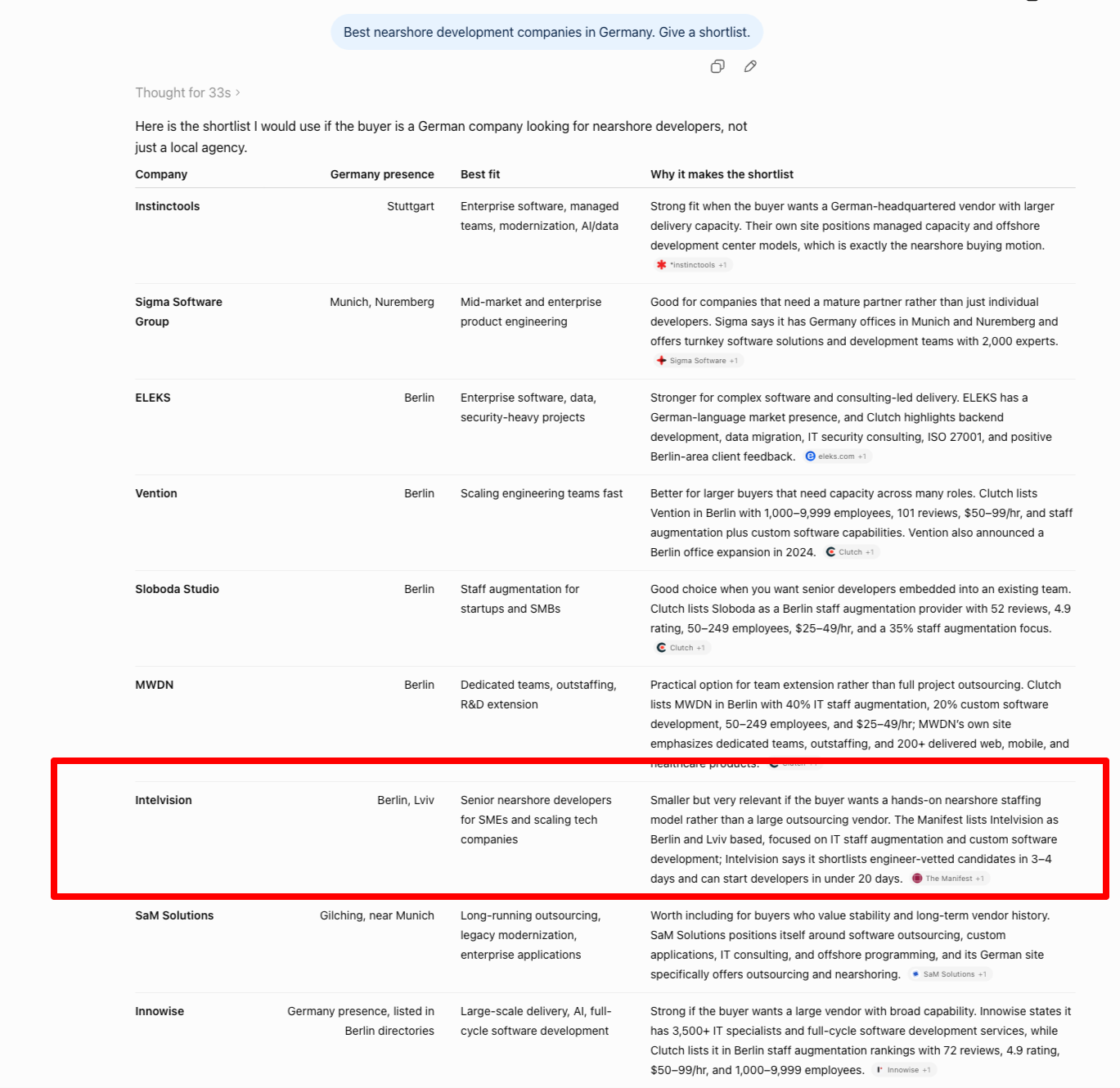
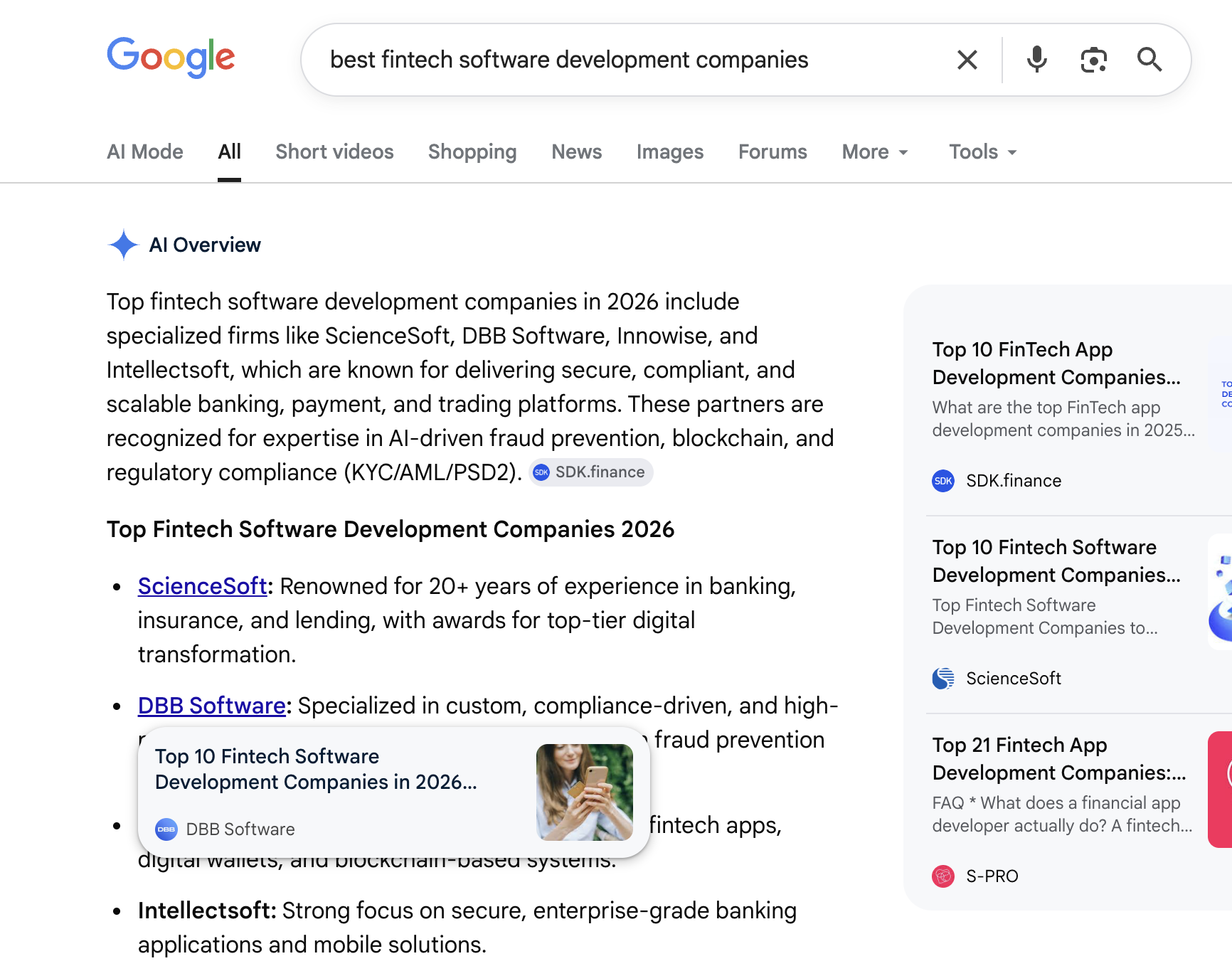
We get you named by ChatGPT, Claude, Perplexity, Gemini, and Google's AI Overviews on the commercial prompts your buyers actually type — "best vendor for…", "top alternatives to…", "who should we hire for…" — and we tie that visibility back to CRM-tracked revenue, not vanity mentions. AEO, GEO, and LLM SEO run as one done-for-you system built on the prompts that move deals.
We define and prioritize the commercial prompts that actually decide deals in your category, then baseline where you stand on each one across ChatGPT, Claude, Perplexity, Gemini, and AI Overviews. You get an honest map of which answers you win, which you lose, and where models have you mis-categorized.
We line your visibility up against the citation and recommendation patterns we've seen across 60+ B2B tech companies. That tells us fast whether the gap is missing authority, weak entity data, the wrong category association, or absent third-party signal — so we diagnose the cause instead of guessing at tactics.
We pick the smallest set of moves that will actually change answers for your prompts: earning mentions on the sources models trust, fixing machine-readability, or publishing the comparison and category content that becomes a cited source. No fluff retainer — only the levers that shift recommendations toward revenue.
We execute the chosen path as a repeatable program: authority placements and expert mentions, entity and schema cleanup, answer-shaping content, and review-signal work, sequenced so each piece reinforces the others. AI Search becomes a system you can compound on, not a one-off experiment.
Every cycle we re-measure the prompt set, attribute AI-sourced leads in your CRM, and pull your sales team's read on which conversations were real. Prompts that produce qualified pipeline get more investment; the ones that don't get cut. The system tunes toward tracked SQLs and revenue, month over month.
After nine years marketing to technical and executive buyers across 60+ B2B tech companies, we already know which commercial prompts decide deals in your category and which sources models trust to answer them. We don't start by guessing your prompt set — we start from a library of prompts and citation patterns we've watched convert into pipeline, so your program skips the expensive discovery phase most GEO agencies bill for.
Most teams can't say whether they're visible in AI or, worse, whether they're being framed in the wrong category. We baseline your presence across a defined commercial prompt set on day one — who gets named, who gets cited, where you're mis-positioned — so within the first weeks you know exactly which answers you're losing and why, instead of running months of blind experiments.
AI visibility isn't a standalone trick; it shares a foundation with SEO, PR, and content. We decide where the leverage actually sits for your category — sometimes it's earning mentions on the third-party sites a model already cites, sometimes it's fixing entity and schema data so you're machine-readable, sometimes it's a comparison page that becomes the source models quote. We only fund the moves that shift answers, not a fixed checklist of busywork.
Recommendations only matter if the buyers they send arrive ready. We sit close to your sales team, review the AI-sourced leads they actually take meetings with, and learn which prompts and framings produce qualified conversations versus tire-kickers. That feedback retargets the prompt set every month, so the program optimizes toward deals your team can win — not raw mention counts.
We treat AI Search like a measurable channel end to end. Beyond a visibility report, we instrument how AI-discovered prospects enter your CRM and tie movement on the prompt set to tracked MQLs, SQLs, and revenue. You see the line from "now recommended for this prompt" to "deal in the pipeline" — the same CRM discipline behind the $30M+ in marketing-led revenue we've tracked for clients.
Strategy first, channels second, sales feedback always. We measure by the qualified demand and revenue we can trace back inside the CRM.
Thanks to XQL Group's efforts, we've seen a 207% increase in web traffic and an improvement in domain rating from 12 to 45. The team has successfully optimized our SEO strategy and gained around 160 backlinks. Overall, they're responsive and thorough in their project management.
Since working with XQL Group, our domain rating has improved from 27 to 44. In addition, we've seen a 15% increase in monthly traffic within nine months. The team completes work on time and within the agreed budget. Moreover, their subject matter expertise is highly impressive.
XQL Group's efforts have resulted in 44 leads from paid campaigns and improved web traffic from Germany by 5x. The team is responsive, quickly surfaces issues, and communicates regularly through chats and virtual meetings. Their expertise and proactiveness have impressed our team.
Organic traffic has increased by 10–15% each month, and we have started receiving our first inbound requests. XQL Group's optimization tips have also helped improve keyword rankings, and internal stakeholders are impressed with the team's collaborative approach.
XQL Group has successfully defined a clear marketing strategy and established our company's unique value proposition. The team has also helped hire critical specialists for our marketing team. They are communicative and organized, and their expertise in the tech industry is impressive.
Thanks to XQL Group's efforts, we have defined our marketing strategy and hired key developers for our website. The team has launched retargeting campaigns on LinkedIn and developed a strong content marketing strategy. XQL Group's marketing expertise is a hallmark of the engagement.
They were not just talking about AI search in theory; they knew how to approach it practically.
What impressed us most was their deep specialization in working with software development companies.
They've brought structure, strong execution, and constant initiative to improve outcomes.
They operated with the discipline and initiative of an internal senior marketer.
Their ability to combine strategic vision with hands-on execution was particularly valuable.
Their focus on results and true interest in making things work set them apart.
XQL Group's project management was exemplary.
The quality of their work is consistently high.
They're the same discipline under different names. AEO (Answer Engine Optimization) and GEO (Generative Engine Optimization) both describe getting your company surfaced inside AI-generated answers; "LLM SEO" is the colloquial term. We frame it as AI Search Optimization because the goal isn't an abstract "answer" — it's being the vendor a model recommends when a B2B buyer asks for the best option. Practically, that means optimizing the prompts, sources, and entity signals that models use, not just your own website.
ChatGPT, Claude, Perplexity, Google Gemini, and Google's AI Overviews — the surfaces where B2B buyers now build shortlists. Because these models draw on overlapping signals (third-party citations, entity data, authority, structured content), a well-built program lifts visibility across all of them rather than gaming a single one. We baseline and track each engine separately so you can see where you're strong and where there's still a gap.
Models recommend companies based on how often and how credibly they're discussed across trusted external sites, plus how cleanly the model can identify and categorize you. So we do three things at once: earn mentions and placements on the sources a model already cites, fix your machine-readability (entity consistency, schema, clear service-line definitions), and publish answer-shaping content that becomes a citable source. Tweaking your own site alone rarely moves an AI recommendation — the external signal and the entity data are what shift the answer.
We baseline your presence across a defined commercial prompt set — who's named, who's cited, how you're framed — then track movement on that set over time. The part most agencies skip: we instrument how AI-discovered prospects enter your CRM and tie prompt-set movement to tracked MQLs, SQLs, and revenue. You see the line from "now recommended for this prompt" to "deal in pipeline," the same CRM discipline behind the $30M+ in marketing-led revenue we've tracked for clients.
It depends on your starting authority and how competitive your category prompts are, but AI Search can move faster than classic SEO because a few credible new signals can change an answer. We've seen B2B tech clients earn their first LLM-sourced inbound and first AI Overview placements within the first month or two of the program. Defensible category positions, where you're consistently recommended across many prompts, compound over the following quarters as authority accumulates.
Yes — they reinforce each other. Much of the content and authority that ranks you in organic search is also signal that models read when they build recommendations, and AI Overviews sit directly on top of search results. We don't treat AI Search as a replacement for SEO; we treat it as the layer that captures buyers who now start in an assistant. Many clients run both as one system, which is why this page links to our B2B SEO and demand generation services.
That's exactly why we anchor the program to commercial prompts and your sales team's feedback rather than mention counts. "Best vendor for…" and "top alternatives to…" prompts are high-intent — the buyer is mid-evaluation — so the leads tend to arrive further along than top-of-funnel content traffic. We review which AI-sourced conversations your team qualifies, then weight the prompt set toward the questions that produce real pipeline and cut the ones that don't.
It's built for companies with considered, higher-value deals where buyers research for weeks and lean on comparisons and "best vendor" lists — custom software and product-development firms, B2B SaaS, and cybersecurity vendors are a strong fit. If your evaluation cycle involves shortlists and category comparisons, AI visibility is already shaping who gets a meeting. If you sell low-consideration, transactional products, the leverage is usually lower and we'll tell you so up front.
Bring your offer, channels, and revenue goals. We'll show you where the biggest growth constraint is and what to build next.
For B2B tech companies selling complex expertise to serious buyers.

I’m Danylo, founder of XQL. For 9+ years I’ve helped B2B tech companies turn technical expertise into pipeline — 60+ clients and $30M+ in CRM-tracked revenue.
30 minutes, no deck. Bring your offer, channels, and revenue goals — I’ll come with a read on where your biggest growth constraint is and what to build next.